Professional Development 4
Conference Paper Review
By Kaelyn Johnson, March 29, 2026
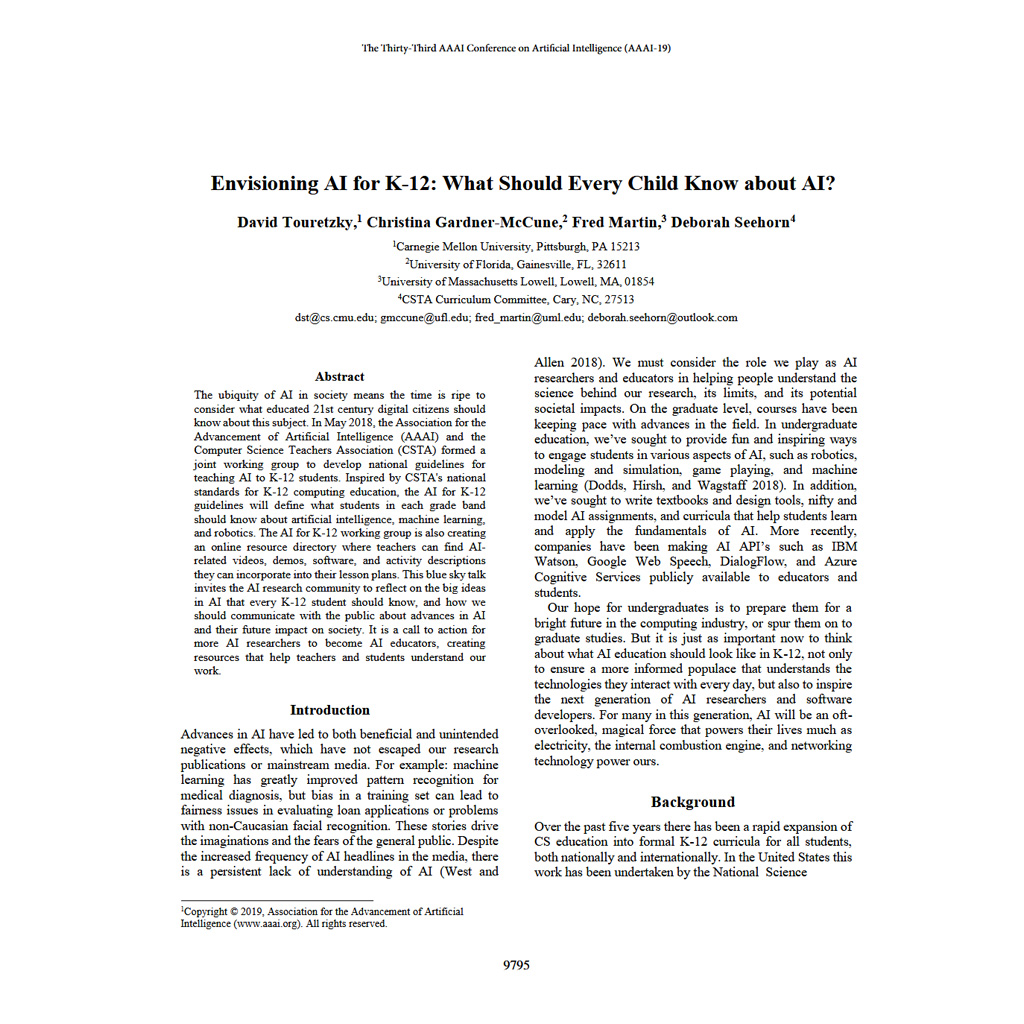
In this conference paper, Touretzky et al. (2019) discussed the importance of educating K-12 students about AI to increase their literacy and to “inspire the next generation of AI researchers and software developers” (p. 9795).
On page 9797, they recommended five “big ideas” that K-12 students should learn about AI within each grade level.
- “Computers perceive the world using sensors” (p. 9797).
- “Agents maintain models/representations of the world and use them for reasoning” (p. 9797).
- “Computers can learn from data” (p. 9797).
- “Making agents interact comfortably with humans is a substantial challenge for AI developers” (p. 9797).
- “AI applications can impact society in both positive and negative ways” (9798).
Touretzky et al. (2019) concluded their conference paper by recommending that AI researchers make educational resources for teachers and students.
The content in this article aligns with scripture and church tradition within the Wesleyan Quadrilateral. For example, verses like Deuteronomy 6:6-7 and Proverbs 22:6 specifically point out the importance of educating children so they know how to conduct themselves as they mature. Teaching children about AI and how to use it ethically now could help cultivate AI stewardship practices and help them in important situations later in life.
The information in this article also aligns with reason. For example, teaching students that AI models “do not think the way a human does” according to the second big idea could help students understand the value of choosing real friendships instead of AI companions (p. 9797). In addition, teaching about how AI generative results come from faulty or biased data sets could help students understand the importance of fact checking before using AI results.
Finally, my own experience with children and teenagers tells me that they are very curious, smart, and eager to jump onto the newest trends, especially if an adult tells them not to without providing a real explanation. I believe that instead of treating AI as “the devil” or simply banning students from its use, teachers should encourage exploration and conversations about what it is, how it affects others, and how to use it effectively.
In conclusion, teachers should train students in the basics of AI to direct their students’ natural curiosity in healthy ways. By implementing the five big ideas from Touretzky et al. (2019), teachers can help every student become responsible stewards of AI.
Work Cited
Touretzky, D., Garner-McCune, C., Martin, F., & Seehorn, D. (2019). Envisioning AI for K-12: What should every child know about AI? The Thirty-Third AAAI Conference on Artificial Intelligence (AAAI-19).
AI Usage:
I used Google AI Overview to help me find Bible verses about educating children.