Professional Development 2
TED Talk Review
By Kaelyn Johnson, February 15, 2026
During this TED Talk, researcher Bryony Cole speaks about the prevalent use of AI companions and shares a checklist for people to consider what their healthy relationships with AI might look like (TED).
According to Cole’s research, “72% of American teenagers have formed relationships with AI companions. More than half use one regularly. One out of six single adults has formed a romantic bond with AI” (TED 00:42-1:00).
Because of the prevalent use of AI intimacy, Cole suggested three questions people can use to monitor their “synthetic intimacy” (3:39-4:05).
Her checklist includes:
1. Can I still embrace the messiness of humanity? (4:34-4:42).
2. Is this a tool for practice, or a way to hide from my problems? (6:46-6:56).
3. How do rules protect me? (8:19-8:29)
Cole ends her talk by assuring her audience that AI companions are okay, but also challenges them to examine if they’re still willing to have “messy human relationships” that teach them “what it means to be alive, together” (12:18-12:57).
When examining the content of this TED Talk from the perspective of the Wesleyan Quadrilateral, scripture provides many verses about godly romantic relationships and friendships.
For example, in Matthew 19:4-6, Jesus confirms that sexual intimacy was designed by God for one man and one woman. In Matthew 19:4-6, Jesus says, “‘For this reason a man will leave his father and mother and be united to his wife, and the two will become one flesh’… So they are no longer two, but one flesh. Therefore what God has joined together, let no one separate” (New International Version).
If God designed sexual intimacy, and Jesus later confirmed this intentional creation, I believe it’s very dangerous to simulate relational intimacy through AI robots. Cole points out in minutes 6:56-7:08 that some benefits of AI include exploring new sexualities, processing grief, or running through difficult conversations (TED). While Cole does emphasize the value of human relationships throughout her talk, she neglects the spiritual component of intimacy. I believe using AI robots to practice intimacy can result in sexual immorality, idolatry, and further spiritual and emotional harm if left unchecked.
Regarding friendships, Cole says that “that friction in intimacy, that’s the feature, it’s not a bug. That’s where we build the muscles of human intimacy, where we learn empathy, communication, listening, patience” (5:27-5:42). I believe this aligns with Proverbs 27:17 which states, “As iron sharpens iron, so one person sharpens another” (New International Version). Instead of manufacturing friendship with AI, we should be actively looking for ways to better ourselves and invest in the lives of others.
Lastly, in 1 Corinthians 6:12, Paul writes, “I have the right to do anything,” you say—but not everything is beneficial. “I have the right to do anything”—but I will not be mastered by anything” (NIV). In minutes 8:34-8:46, Cole states that AI companions have addictive capabilities. These verses show that while we might have the right to use AI companions, we should not let them have mastery over us.
In addition to scripture, tradition and reason show that friendships and romantic partners should involve relationships between actual humanity. Traditionally, the Church has upheld the sanctity of marriage between one man and one woman. Therefore, using AI in place of a man or a woman goes against church tradition. In addition, reason shows that relationships with AI cannot be as fruitful as relationships with real human beings, as Cole pointed out in minutes 5:27-5:42 (TED).
Finally, my experience with friendships has shown me the incredible value of real relationships. My friends have listened to me, comforted me, and even helped me address faults in my life. I have truly become a better person because of them.
In conclusion, I believe we should be wary of using AI companions for our relationship needs. Human connection is God ordained and can fulfill us in ways robots cannot. We should intentionally seek out friendships so we can better ourselves and the lives of others.
Works Cited
[TED]. “The AI-Generated Intimacy Crisis | Bryony Cole | TED.” YouTube, 14 Feb. 2026, https://www.youtube.com/watch?v=zSMcLEZgEeE
New International Version. BibleGateway, https://www.biblegateway.com. Accessed 15 Feb. 2026.
AI Usage:
I used Google Gemini to transcribe this YouTube video. Here is a screenshot of my process:
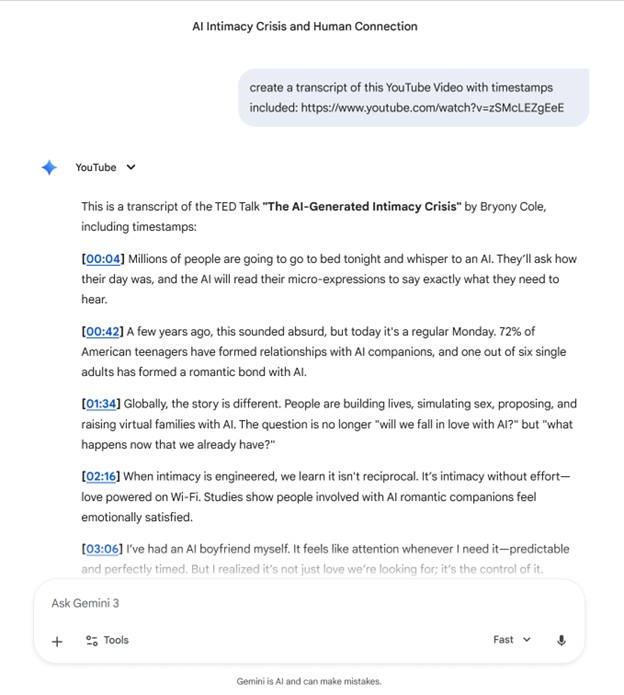
The transcription helped me identify the general location of topics within the video and made the citation process easier. It did not provide me with a word-for-word transcription, so I had to look through the YouTube video for exact quotations and timestamps.