AI Tool: Suno
Infographic
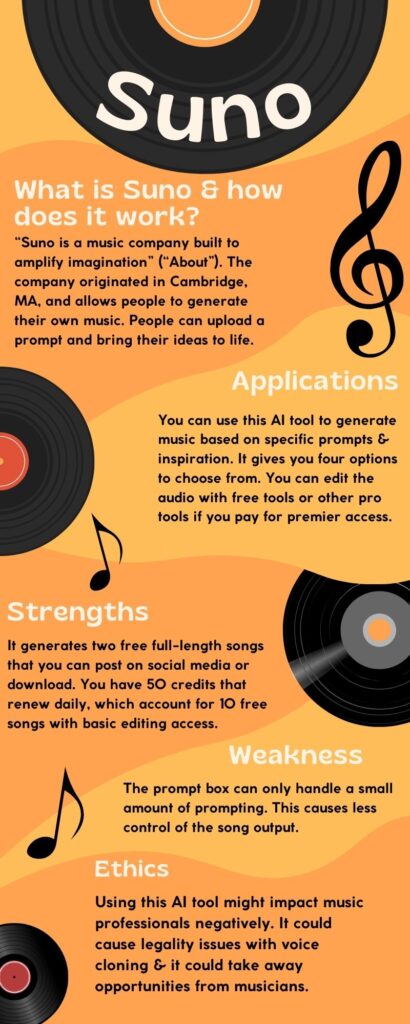
Work Cited
“About.” Suno, Suno, https://suno.com/about. Accessed 22 Feb. 2026
I made this graphic with Canva.
Artifact & Description
Artifact
First, I decided to put a long free-verse poem into Suno to generate a song. Unfortunately, the prompt was too long, so I had to shorten it by putting the poem into ChatGPT. It generate one verse and chorus.
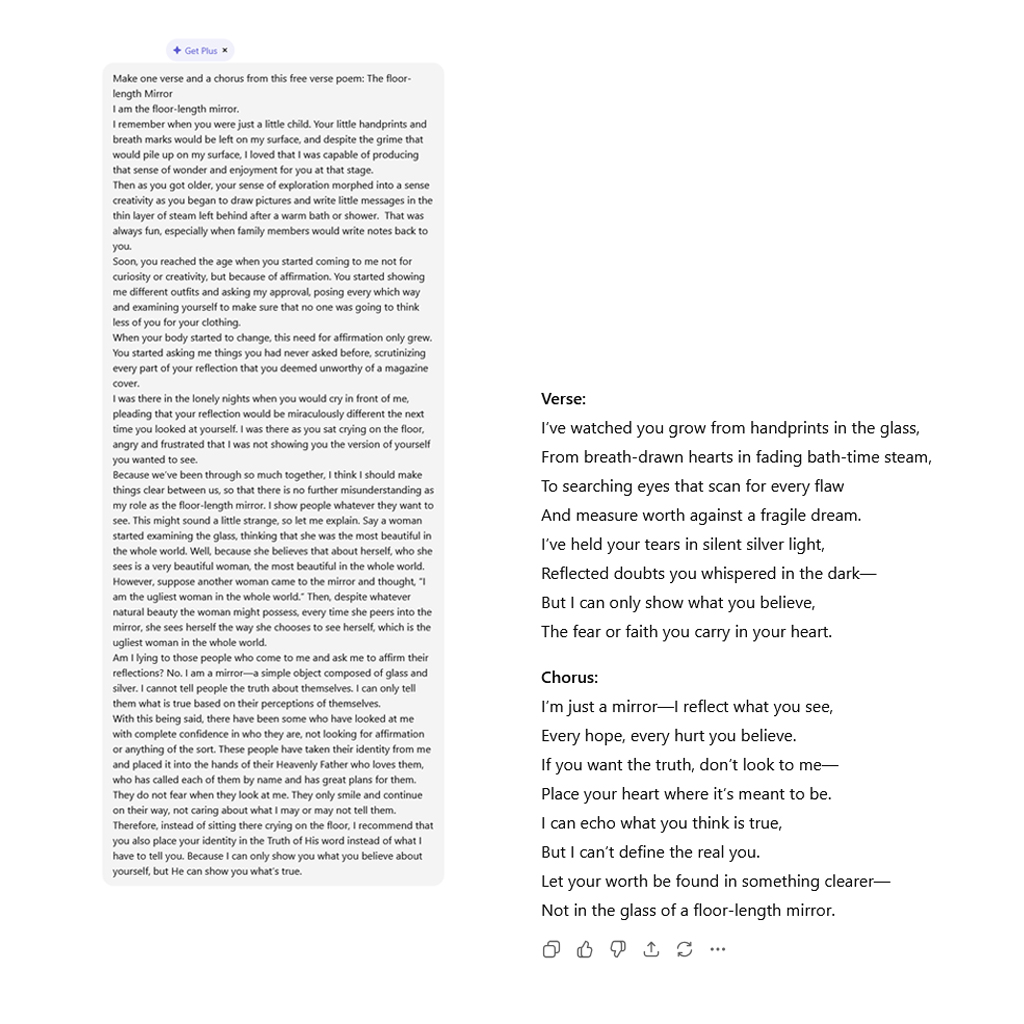
I put the new chorus and verse into Suno, but the description was still too long. I decided to just add the chorus, and I was finally able to press the create button. It generated four videos.
Here are screen recordings of the songs it generated. The first recording includes snippets of songs I could get by paying extra money.
The second recording includes full versions of two free songs.
Then, I decided to change the prompt slightly:
“Generate a song with a female voice singing in gentle lofi pop style music with this chorus:
I’m just a mirror—I reflect what you see,
Every hope, every hurt you believe.
If you want the truth, don’t look to me—
Place your heart where it’s meant to be.
I can echo what you think is true,
But I can’t define the real you.
Let your worth be found in something clearer—
Not in the glass of a floor-length mirror.”
It gave me the following four songs. The first screen recording shows the two paid versions.
The second screen recording shows the free full versions.
Then, I decided to play with the extra editing tools.
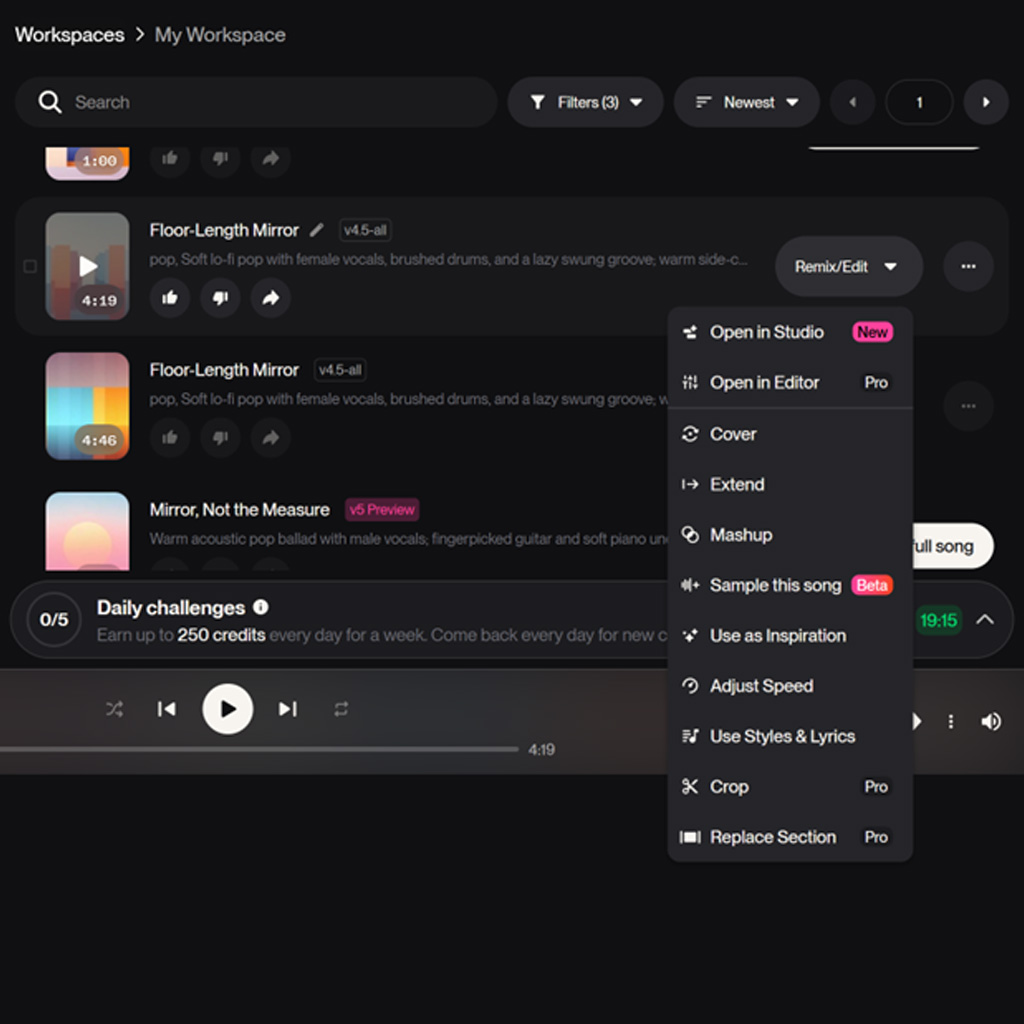
I decided to play with the mashup tab first. Here is a screen recording of my process.
Finally, I decided to adjust the speed of a mashed up song. This recording shows my process.
Description
I chose to analyze Suno, an AI tool used to generate songs. First, I attempted to upload the entire free verse poem I had written as the prompt, but the poem was too long. I decided to use ChatGPT to generate a chorus and verse based on my poem, and then I uploaded the chorus to Suno. It generated four songs, and then I decided to change the prompt for different results. Afteward, I created a mashup between a song generated by the first set of promptings and by a song generated by the second set of promptings. I then experimented with the speed tool. I used the screen recording and screenshot tools on my laptop to show my process and used Photoshop and Adobe Premiere Pro to edit them.
Here is the citation for Suno:
“Create.” Suno, Suno, https://suno.com/create. Accessed 22 Feb. 2026.
Here is the citation for ChatGPT:
“Make one verse and a chorus from this free verse poem: The floor-length Mirror” prompt. ChatGPT, Open AI, 21 Feb. 2026. https://chatgpt.com/c/699a2f92-6f88-832a-8e84-eac88195fa00.
Reflection/Analysis
By using Suno (and ChatGPT), I turned my long free-verse poem into several inspirational songs. AI supplemented what I lacked in my current skillset (such as songwriting and poetry skills) and helped me experiment with a different medium that could bring enjoyment to others. I had everything I needed to create and quickly edit a basic song for free, but I could do even more advanced work with the paid plans. I wish I could make the prompt longer to more accurately reflect my poem, but with enough specific promptings, mashups, and editing, I could probably make a song very close to what I imagined.
Let’s examine Suno within the framework of the Wesleyan Quadrilateral (scripture, tradition, reason, and experience) to determine how we can use it ethically.
Scripture: Music is referenced all throughout scripture. One early reference to music occurs in Genesis 4:21 and specifically mentions a musical ancestor. Music has been used to worship God, such as Miriam’s song in Exodus 15, and to celebrate important events, such as the end of the Passover meal in Matthew 26:30. I believe the most obvious example of the scriptural value of music is the entire book of Psalms dedicated to songs written by King David and others. The Holy Spirit can inspire songs, and those songs should be used to bring glory to Him. I believe Suno could be an avenue in which a person typically ungifted in writing poetry and music could carry out his Spirit-given desire. His or her song, though generated by AI, could still bring God glory and edify others if done with the right intentions.
Tradition: The use of AI goes against traditional ways of creating music and songwriting, but I believe its use could be acceptable as long as humans stay involved in every step of the creative process.
Reason: The voices generated along with the songs sound very realistic, which has caused people to feel uneasy about music-generating tools. First, the lifelike nature of an AI bot and the music it generates might eliminate the need to collaborate with an actual songwriter and singer. This may take away opportunities from those who do have songwriting and poetry gifts. Second, this tool may cause others to become lazy. Instead of working hard to develop poetry and song writing skills, people might turn to a robot out of convenience. Therefore, they might have impressive work to show others, but they have not grown as human beings in the process. Third, Suno and other AI music generating services have faced lawsuits and legality issues based on their use of copyrighted songs for training data (“Record Companies”). Therefore, I believe music produced by an AI tool should not as the final product. Instead, it should be used as a guide to help people see the potential in their work. I believe generating a song with AI and then having someone with musical talent re-record the song with their unique style could be one way to use Suno ethically.
Experience: My own experience in the musical settings like choir and theater show me the incredible value of human-made music that AI should never replace. However, my experience also shows me that AI could help me (who does not write songs) also contribute to the world of music with content that could please God and others.
Work Cited
“Record Companies Bring Landmark Cases for Responsible AI Against Suno and Udio in Boston and New York Federal Courts, Respectively.” News, RIAA, 24 June 2024. https://www.riaa.com/record-companies-bring-landmark-cases-for-responsible-ai-againstsuno-and-udio-in-boston-and-new-york-federal-courts-respectively/.