Professional Development 3
Forbes Article Review
By Kaelyn Johnson, March 15, 2026
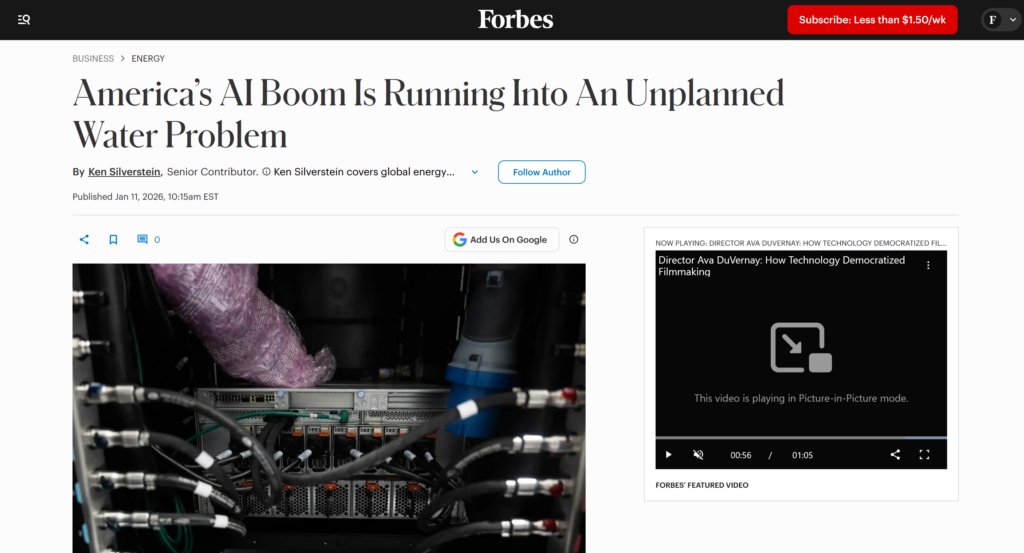
In this article, author Ken Silverstein addresses the increase of data centers and need for strategic regional planning to protect water supplies. He writes:
“The issue isn’t that the United States is building too many data centers. It’s that a nationally significant industry is expanding through a patchwork of incentives, and water systems never intended to support infrastructure on this scale” (Silverstein).
People in charge of zoning the centers don’t often consider the long-term effects of water consumption in a given area (Silverstein). While a center may be near an abundant water source, drought can still occur due to the center’s cooling system. However, he also claims that since AI data centers are an integral part of the US now, stopping their productions because of water consumption seems unrealistic (Silverstein).
Instead, he proposes that the same level of planning assigned to power plants and highways be applied to data centers. He wrote, “Standardized reporting, transparent metrics, and alignment with local drought planning would allow utilities and communities to price risk and plan infrastructure upgrades before shortages emerge.” If people carefully considered long-term consequences of data centers in an area before building them, they could coexist peacefully in the environment without taking away a community’s valuable resource.
When examining Silverstein’s article within the context of the Wesleyan Quadrilateral, I found that scripture and church tradition explains humanity’s mandate from God to care for the all who live in the environment (Genesis 1:26-28). In addition, in Proverbs 21:5, Solomon writes about the value of planning ahead (Proverbs 21:5). Therefore, people should perform extensive research on the location of these data centers before building them since the centers could cause severe damage to the environment.
In addition to scripture, reason shows that planning ahead for future droughts could protect those who live near data centers.
Finally, my own experience of hearing classmates talk about data centers near their own hometowns shows the need to carefully survey locations to determine if the centers will ultimately harm surrounding residents or not. The people living in the surrounding areas are more than numbers on a census. They are real people with friends who care about them.
In conclusion, this article helped me understand that data centers can coexist with the environment if careful planning strategies are implemented. Knowing what the data centers do to the environment and the ways to remedy those effects could help me make an informed decision as a voting citizen in the future.
Work Cited
Silverstein, Ken. “America’s AI Bloom Is Running Into an Unplanned Water Problem.” Forbes. 11 Jan. 2026. https://www.forbes.com/sites/kensilverstein/2026/01/11/americas-ai-boom-is-running-into-an-unplanned-water-problem/.
AI Usage:
I used Google AI Overview to help me find Bible verses about planning ahead.